Contents
06 Understanding ADHD
Complex yet common, ADHD gives individuals
unique strengths and challenges
12 Women and hormones
How the menstrual cycle and menopause affect
women who live with ADHD
16 Seeking a di
...
Contents
06 Understanding ADHD
Complex yet common, ADHD gives individuals
unique strengths and challenges
12 Women and hormones
How the menstrual cycle and menopause affect
women who live with ADHD
16 Seeking a diagnosis
We walk you through the process
of getting diagnosed
20 ADHD in adulthood
We’ve spoken to two people who received an ADHD
diagnosis as adults
28 Treatments and coping
mechanisms
There are many ways to manage ADHD, from
medication to therapy and self-help
34 Comorbidities
How other conditions present with ADHD,
including other neurodiversities, as well as
anxiety and depression
38 What is masking?
We explain what the concept of ‘masking’ is,
and what the effects of it can be
42 Supporting your child
Failing to recognize ADHD can cause children to
struggle academically and socially
50 The emotional rollercoaster
Emotional dysregulation is rife among those
living with ADHD
58 Feeling inferior
Neurodiverse people may struggle with self-esteem.
Why is that, and how can you heal?
62 Executive dysfunction
We explore what executive function is, and how it
can be impacted in those with ADHD
70 Feeling overwhelmed
Why do those with ADHD experience overwhelm,
and how can you handle it?
76 A matter of interest
The interest-based nervous system helps us
understand attention and motivation
84 Improve memory and
concentration
Tips and tricks to boost your working
memory and focus
88 The ‘F’ word
When friends seem few and far between, ADHD
may be playing havoc with your social life
94 ADHD in the workplace
Embracing your ADHD can lead to a
fulfilling work life6
Understanding ADHD
Words Julia Mitchell
Understanding
ADHD
A complex yet commonly experienced disorder, Attention
Deficit Hyperactivity Disorder (ADHD) gives individuals
a unique combination of strengths and difficulties
subtype, and are then diagnosed
accordingly. For example, an
individual with predominantly
inattentive ADHD might experience
difficulties following instructions and
concentrating in class. This subtype
is also known as ADD, although the
term is now less frequently used.
Other people with predominantly
hyperactive/impulsive ADHD might
find themselves interrupting others
during conversations and find it
difficult to sit still, while people
diagnosed with combined type ADHD
will possess a combination of the
two sets of symptoms. Although
thinking about ADHD in this way
can help people to gain a stronger
understanding of how they see and
interact with the world, it’s important
to remember that this is a rough
guide, and a person’s symptoms will
often not fit neatly into one box.
What causes
ADHD?
Although it’s not known exactly what
causes ADHD, it’s thought that a
number of factors may be involved.
The first of these is genetics, and
research has found that ADHD often
runs in families. This means that
A common form of
neurodiversity, ADHD is
a condition that usually
begins in childhood
and lasts for someone’s entire life.
Although it can cause a variety of
difficulties in everyday functioning
for both children and adults, people
with ADHD also have many strengths
that make them fantastic family
members, friends and employees. It’s
likely that you know someone who
has ADHD – it’s estimated that three to
four per cent of adults in the UK live
with the condition, with around five per
cent of children meeting the diagnostic
criteria globally. Recent years have
seen increased awareness about
ADHD, predominantly due to social
media, which has led to an increase in
individuals seeking a diagnosis.
What are the
different types
of ADHD?
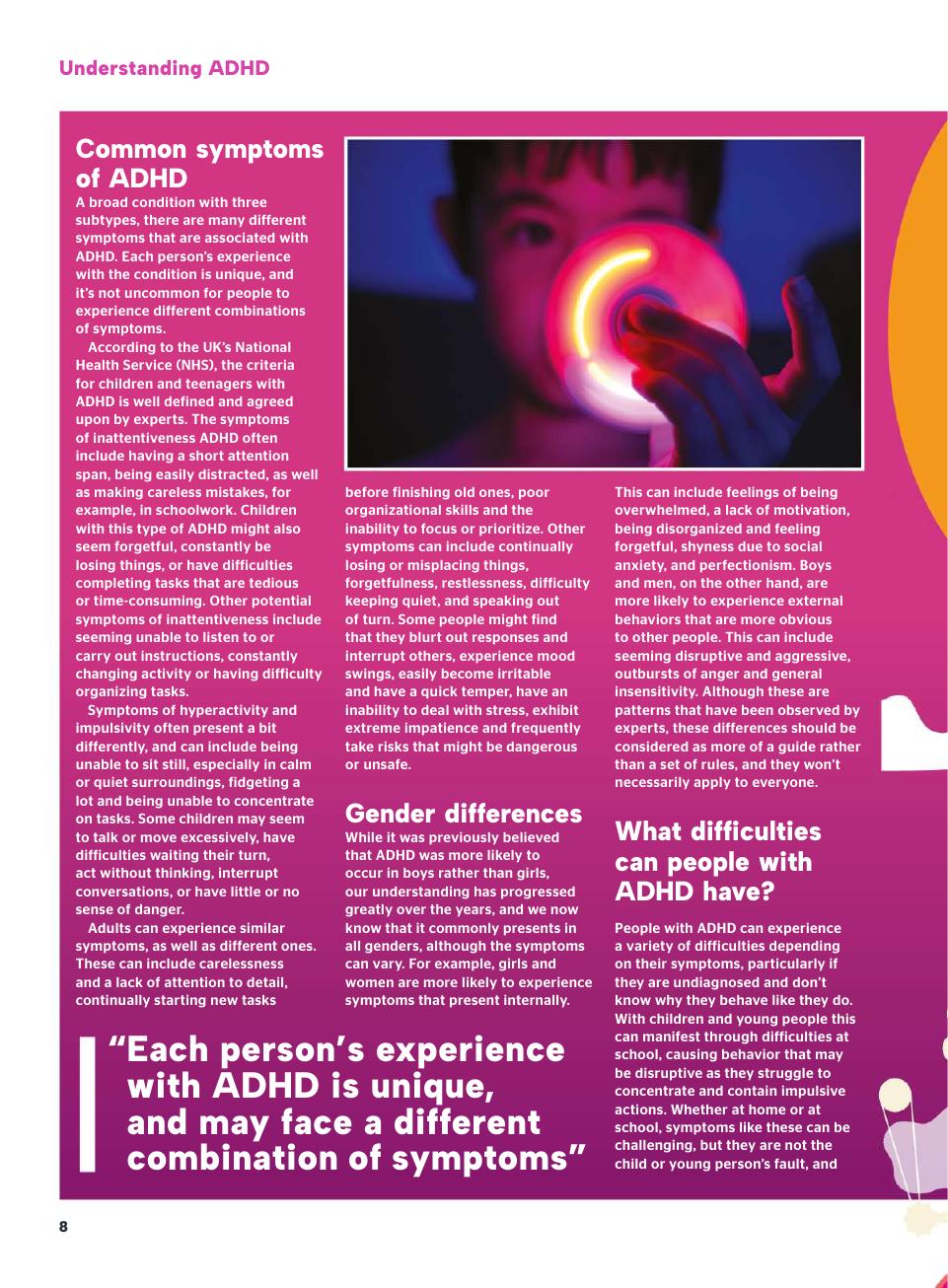
ADHD is an umbrella term that can
be broken down into three main
subtypes: hyperactive/impulsive,
inattentive, and combined. The
idea behind this is that people
generally present with different
symptoms depending on the
children who have relatives with
ADHD are four times more likely
to also have the condition. Other
groups that are found to be at an
increased risk of developing ADHD
include people with traumatic
brain injuries and epilepsy, as
well as those who were born
prematurely or at a low birthweight.
It’s thought that essential brain
development occurs in the later
stages of pregnancy, and babies that
are born significantly early miss out
on this brain development happening
before birth.
Other research has identified
changes in the brains of people with
ADHD. For example, a part of the
brain called the prefrontal cortex
– which helps with emotional
control, time management,
organization and problem-solving –
is often smaller in children with the
condition. Brain chemicals known
as neurotransmitters also vary in
those with ADHD, and this includes
lower levels of the pleasure chemical
dopamine, which is involved in the
brain’s reward system. While experts
have much to learn about the causes
of ADHD, research is ongoing,
meaning that we might one day
have a clearer picture about how
it develops.
[Show More]
Preview 10 out of 100 pages